
Techniques
DHI Hair Transplant Explained: What the Implanter Pen Changes
Medically reviewed by Dr. Kadir Devrim Demirel on
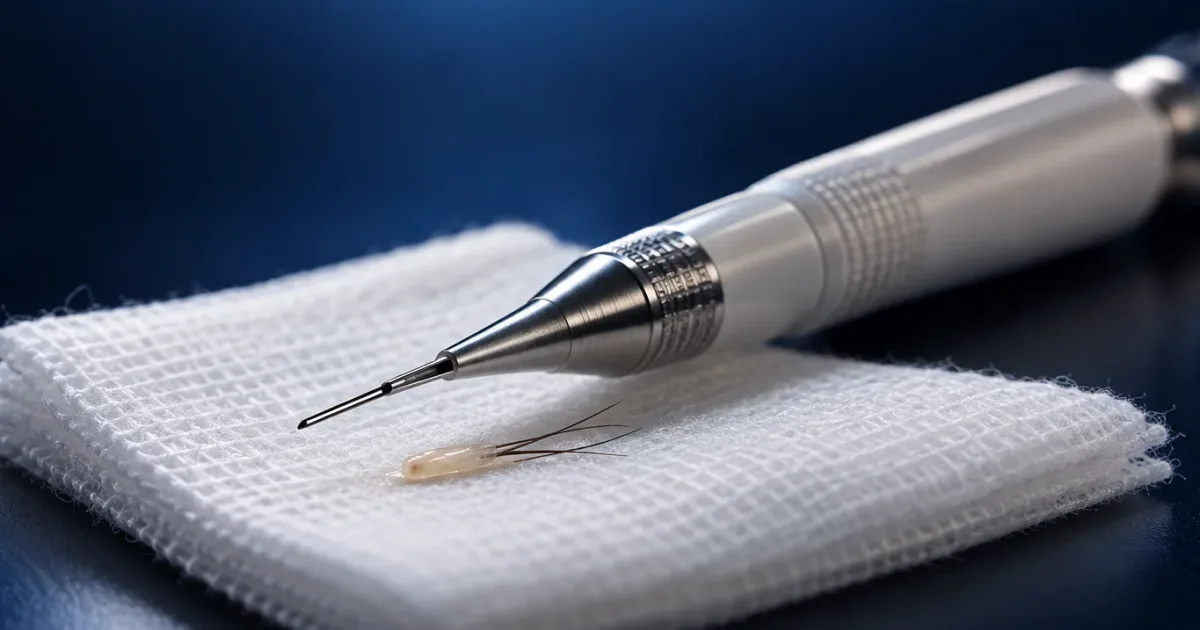
DHI is a way of placing FUE grafts with a pen-like implanter instead of forceps. This guide explains what changes, what a published study measured, what the evidence does not yet show and how the method is chosen.
Key facts
- DHI (direct hair implantation) uses the same extraction step as FUE. The difference is how grafts are placed.
- In DHI, each graft is loaded into a hollow-needle implanter and placed in one movement. In classic FUE, small incisions are made first and grafts are placed with fine forceps.
- A 2017 study of 482 grafts placed with sharp-needle implanters found new damage in 0.5% of hairs after placement.
- That study did not compare implanters with forceps. We are not aware of strong evidence that one method gives higher graft survival than the other.
- The method should be chosen for your hair, your skin and the area to be treated, by a team experienced in it.
How DHI works
Every hair transplant has two main steps. First, grafts are taken from the donor area, usually the back of the head. Second, they are placed in the area with hair loss.
In DHI, extraction is done in the same way as FUE, one graft at a time with a small punch. For placement, a team member loads each graft into an implanter, a pen-like instrument with a hollow needle. The doctor then inserts the needle at the chosen angle and depth and releases the graft. Making the opening and placing the graft happen in a single step.
In classic FUE, the doctor first makes all the small openings, called recipient sites, and the grafts are then placed into them with fine forceps.
What a published study measured
Von Albertini and von Albertini studied FUE procedures in 7 men in Switzerland, with 15,147 grafts placed with sharp-needle implanters. They examined 482 grafts, containing 1,292 hairs, before loading and after placement.
New damage after placement was found in 6 hairs, or 0.5%. There were no crush injuries. The share of hairs with any damage, including damage already present from extraction, was 8.1% before placement and 8.6% after, which was not a statistically significant difference. The team placed grafts at a rate of about 1,000 per hour, and grafts were out of the storage solution for 8.2 seconds on average.
[[grafik:1]]The authors state that they did not compare implanters with forceps. Their results apply to sharp-needle implanters and to grafts extracted with a sharp punch. The study shows that implanters can place grafts with very little extra damage. It does not show that DHI grows more hair than forceps placement.
Possible advantages and limits
Clinics that use DHI often point to control over the angle and direction of each graft and to less handling of the graft during placement. These points depend heavily on the skill of the team.
DHI also has practical limits. It needs several implanters and trained staff to load them, and placing a large number of grafts can take longer. For some areas or hair types, forceps placement may suit better. A good clinic will explain why it recommends a method for you rather than using one name for every patient.
DHI and afro-textured hair
For curly and coily hair, the hardest step is usually extraction, because the follicles curve under the skin. The placement method matters less than whether the extraction technique is adapted to the hair and skin. Our guide to afro hair transplants covers the published studies.
How the method is chosen
- Your doctor examines your donor area, hair type and the area to be treated.
- The number of grafts and the hairline design are planned first.
- The placement method is then chosen for that plan.
Read more on our DHI page and FUE page, or send us photos for a personal assessment.
Frequently asked questions
Is DHI better than FUE?
DHI is a form of FUE that uses an implanter for placement. We are not aware of strong evidence that it gives higher graft survival than forceps placement. The suitable method depends on your hair, skin and treatment area.
Does DHI require shaving?
The donor area is usually trimmed for extraction. Whether the recipient area needs trimming depends on the plan, so ask your doctor during the assessment.
Is DHI suitable for afro hair?
It can be. With afro-textured hair the extraction step is usually the more demanding one, so ask how the team adapts extraction to curved follicles.
References
- von Albertini C, von Albertini MA. Does the use of implanters affect the quality of FUE grafts? Hair Transplant Forum International. 2017;27(3):96-99. www.ishrs-htforum.org
More guides
How to Read Hair Transplant Reviews and Before-and-After Photos
Reviews and before-and-after photos are the evidence most patients use to choose a clinic, and both can mislead. This guide explains how to judge a photo, how to spot an unreliable review and what the law in the US, UK and Türkiye says.
DHI vs FUE vs Sapphire FUE vs FUT: Hair Transplant Techniques Compared (2026)
DHI, FUE, sapphire FUE and FUT are often presented as competing products. In fact they describe different steps of the same surgery. This guide explains what each name means, what the evidence shows and how the method is chosen.
Afro Hair Transplant Clinics in Turkey: How to Choose One for Curly and Coily Hair
Afro-textured hair needs a clinic with specific experience, because curved follicles change how grafts are extracted. This guide sets out the questions to ask, the evidence behind them and the warning signs to watch for.
This article is for general information and does not replace a medical consultation. Results vary from person to person. Your doctor will explain what is realistic for you after an assessment.
Get a free online assessment
Send us a few photos. Our team reviews your case and replies, usually within one business day.